
How to specify grain direction for folding cartons: confirm the opening, scores and imposition together
Confirm carton grain direction through the actual stock, carton structure, score direction and relevant folding proofs.
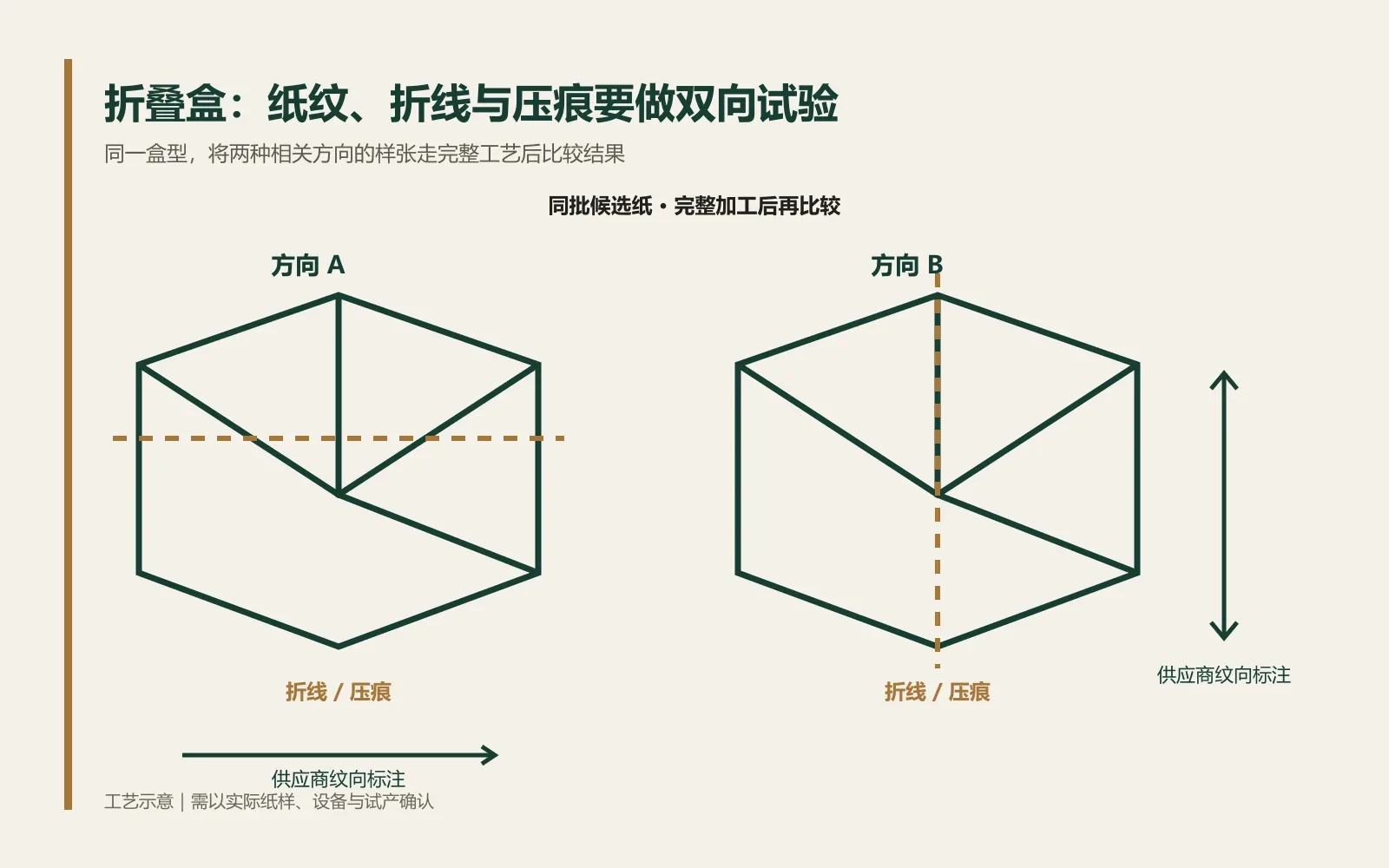
Treat grain as a production input
Grain direction should be a production input, not a late-order tick box. Paper responds unevenly to moisture changes across and along its grain. Sappi notes that adverse exposure can contribute to wavy or tight edges, register variation, wrinkles and fold cracking. That principle does not prescribe one direction for every carton: the actual sheet, carton geometry, score direction, artwork and production route must be assessed together.
Use one structural and imposition brief
Start with one shared structural drawing. Mark the front and reverse, main opening edge, scores, glue flap, large solids and the small type or codes that cannot move. Add the proposed sheet size, the supplier’s grain notation, press feed direction and imposition. This turns a size request into a brief that the supplier, printer and converter can act on.
Prove the relevant directions on the intended structure
Do not make a grammage-only rule. Paper construction, coating, moisture condition, crease tool, fold radius and ink coverage all affect the result. Produce samples in the relevant directions from the proposed stock and run the intended structure through printing, drying, creasing, die-cutting, folding and gluing. Include dark solids over scores, reverse type, barcodes, foil or varnish boundaries, short tabs and the tightest opening. Check first fold and repeated opening for cracking, image damage, rebound, corners and fit.
Record the approved production inputs
Record the approved stock reference, grammage, size, supplier grain mark, imposition revision, side to print, carton dieline revision and approval date. A familiar name or a photo does not transfer a previous grain decision to a new sheet, layout or press. Reconfirm when any of those inputs changes.
Project checklist
Does the structural drawing mark the opening, key scores, glue flap and immovable artwork?
Do the quotation and order state size, supplier grain mark, print side and imposition revision?
Has the intended stock been printed, creased, die-cut and folded in the relevant directions?
Has the approval been revalidated after a stock, structure, coverage or equipment change?
Short guide: four checks before sampling
An original silent explainer with Chinese captions. The diagrams illustrate process checks, not photographs or performance results for a specific paper grade.
Sources and scope
Prepared using the references below, checked on 9 October 2026. Recommendations for different brands and grades are not interchangeable; confirm production conditions against the selected grade's documentation and physical press trials. Illustrations and animation are original explanatory graphics.