
How to approve specialty paper for digital printing: “runs through” is not “ready to deliver”
Approve digital-print suitability through complete evidence for feeding, image, finishing and delivery.
A successful feed is only the first observation
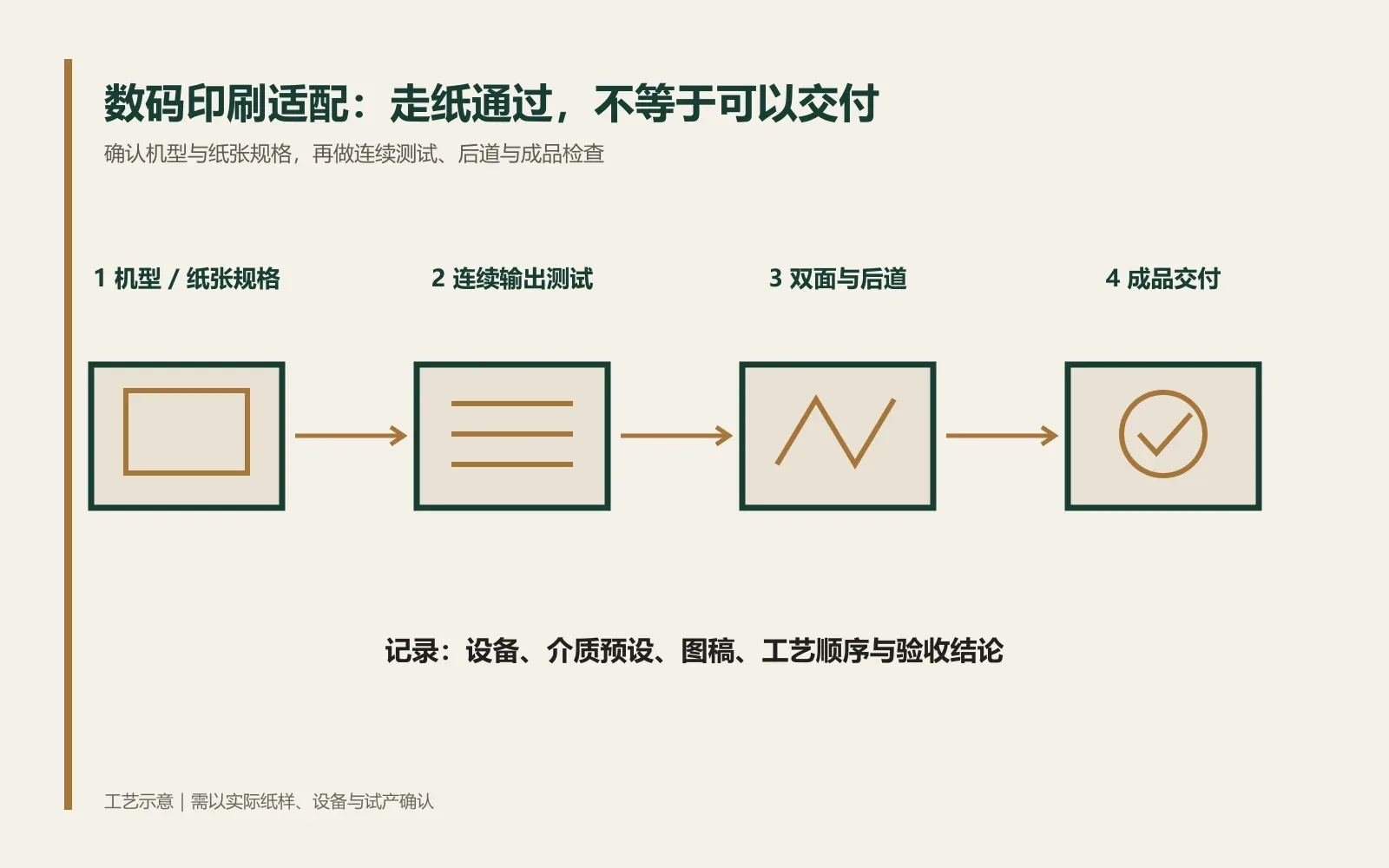
Passing through a digital press is only one observation. Approval for a specialty paper must cover the complete delivered object: stable feeding, uniform image transfer, readable small type and codes, duplex registration, fold behaviour, and the result after foil, varnish, lamination, gluing and handling.
Do not transfer external machine settings
An Antalis-hosted creative-paper guide explains how the peaks and valleys of a texture can lead to incomplete transfer on particular digital systems. It does not set machine values for QiLi grades. The practical conclusion is that measured caliper alone does not determine a suitable media preset. Compatibility information, printer experience and a job-specific proof are all required. The printer should make machine adjustments under the equipment and consumable suppliers’ guidance; an external value must not be copied into another press.
Specify the intended digital route early
Specify the intended digital route at sampling and quotation: press make/model if known, toner or liquid-ink system, simplex or duplex, size and grammage, texture or coating, maximum coverage, white ink, and all planned finishing. If the press is undecided, state that the paper remains subject to proofing on the nominated equipment.
Approve the delivered object through four checks
Approve four evidence panels: a continuous-run panel for feeding and stacking; an image panel with solids, hairlines, reverse type, gradients and codes in the strongest texture; a duplex and finishing panel with the actual score, fold and planned embellishments; and a delivery panel for post-cure rub, cutting, packing and scan performance on the final object. Preserve both the printed sheet and finished sample with the stock/batch reference, press, media-preset revision, artwork, process order and result. Reproof when the press, batch, size, coverage or finishing changes.
Project checklist
Has a continuous run checked feeding, stacking, marking, edges and double-sheet risk?
Does the image panel include solids, hairlines, reverse type, gradients and a production-size code in the texture?
Have duplex alignment, creasing, folding and surface treatment been checked in the actual process order?
Are the printed sheet, finished sample, press/media-preset revision and scan or acceptance result retained?
Short guide: four checks before sampling
An original silent explainer with Chinese captions. The diagrams illustrate process checks, not photographs or performance results for a specific paper grade.
Sources and scope
Prepared using the references below, checked on 9 October 2026. Recommendations for different brands and grades are not interchangeable; confirm production conditions against the selected grade's documentation and physical press trials. Illustrations and animation are original explanatory graphics.
Antalis / Arjowiggins Creative Papers, Printing and finishing guidelines