
Spot UV on specialty paper: what to check on pearl, mirror-gloss and soft-touch surfaces
UV is not suitable on every paper by default. Adhesion, cure, gloss contrast and folding are the four things to check — and how to proof on each surface.
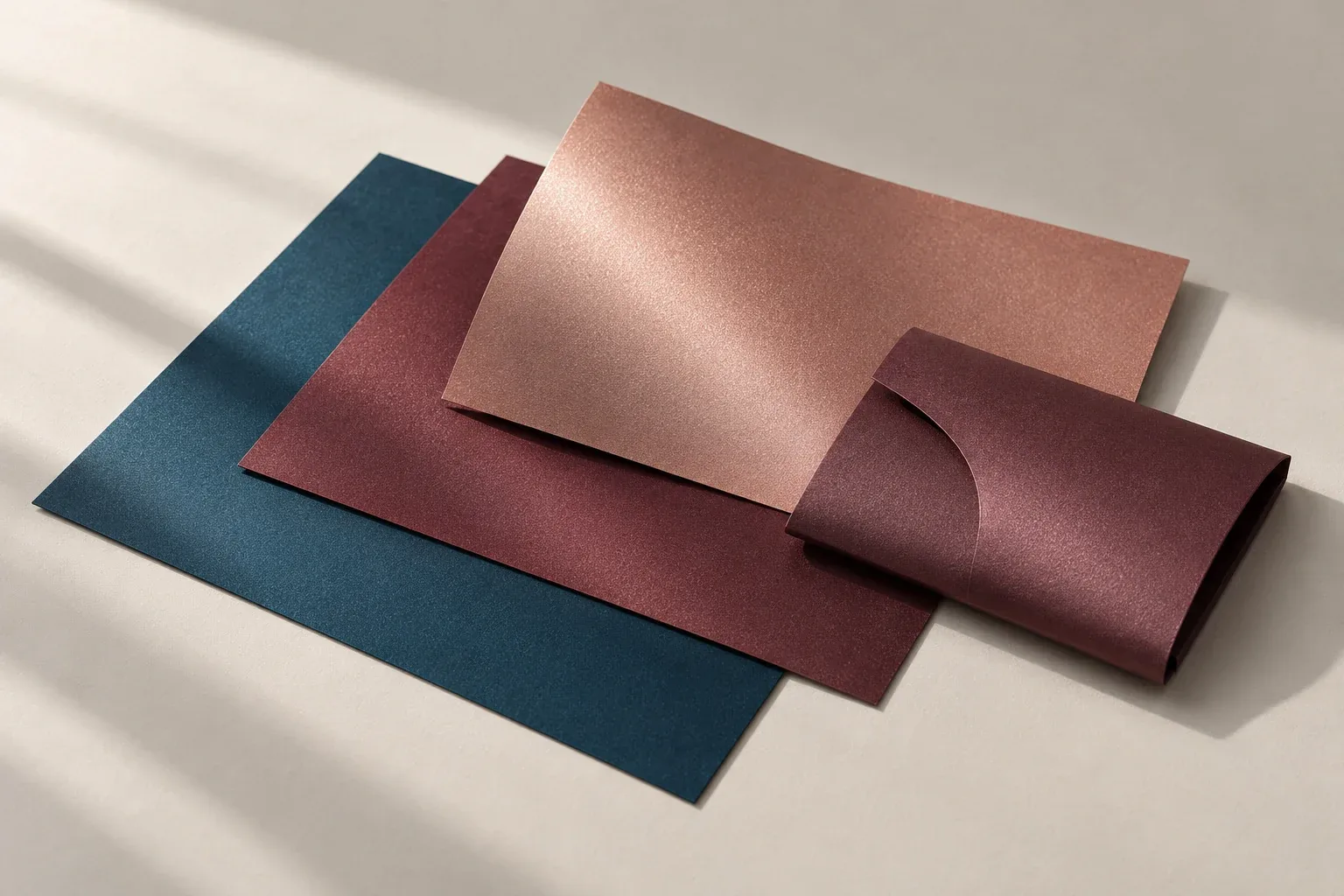
Spot UV works through gloss contrast: one bright area on a matt surface, or one matt area on a bright one. But UV is not suitable on every paper by default. VANGLAM's rule is that UV is used only on stocks confirmed by a project-specific proof.
What are the four things to check?
Adhesion: on smooth, non-absorbent surfaces, UV ink or varnish adhesion has to be tested separately.
Cure: under-cured UV stays soft and scratches easily, so confirm lamp energy and press speed.
Gloss contrast: pearl and metallic surfaces already shine, so UV contrast may be weaker than on a matt sheet.
Folding: UV films are hard and crack easily across a fold, so keep them off score lines.
Where to start on each surface
White pearl (HALO): not every grade takes UV by default, so proof on the selected grade first.
Coloured pearl (CHROMA): check whether the UV separates clearly from the pearl sheen.
Mirror gloss (GLAZE): the surface is already bright, so consider a matt effect for contrast, after testing adhesion.
Soft touch (SOFTSKIN, PEARLSKIN): bright UV on a matt, soft surface gives the strongest contrast, but how the coating and UV bond is confirmed per grade by proof.
Uncoated and textured (素映, GRAINFORM, EARTH): absorbency and texture affect UV smoothness and edges; a heavier film or a different finish is often needed.
Three tests for every proof
Tape test: after curing, press tape on and pull it off quickly to check for lifting.
Scratch test: draw a fingernail lightly across the UV and look for marks.
Fold test: fold at the real score position and check for cracking.
Printing and finishing suitability for VANGLAM papers is confirmed for the selected grade and the actual process.