
Specialty paper glossary: grammage, caliper, bulk, grain direction, colour-through and Master Sample
The 12 terms brands, designers and printers use most when specifying specialty paper — each explained in a sentence or two.
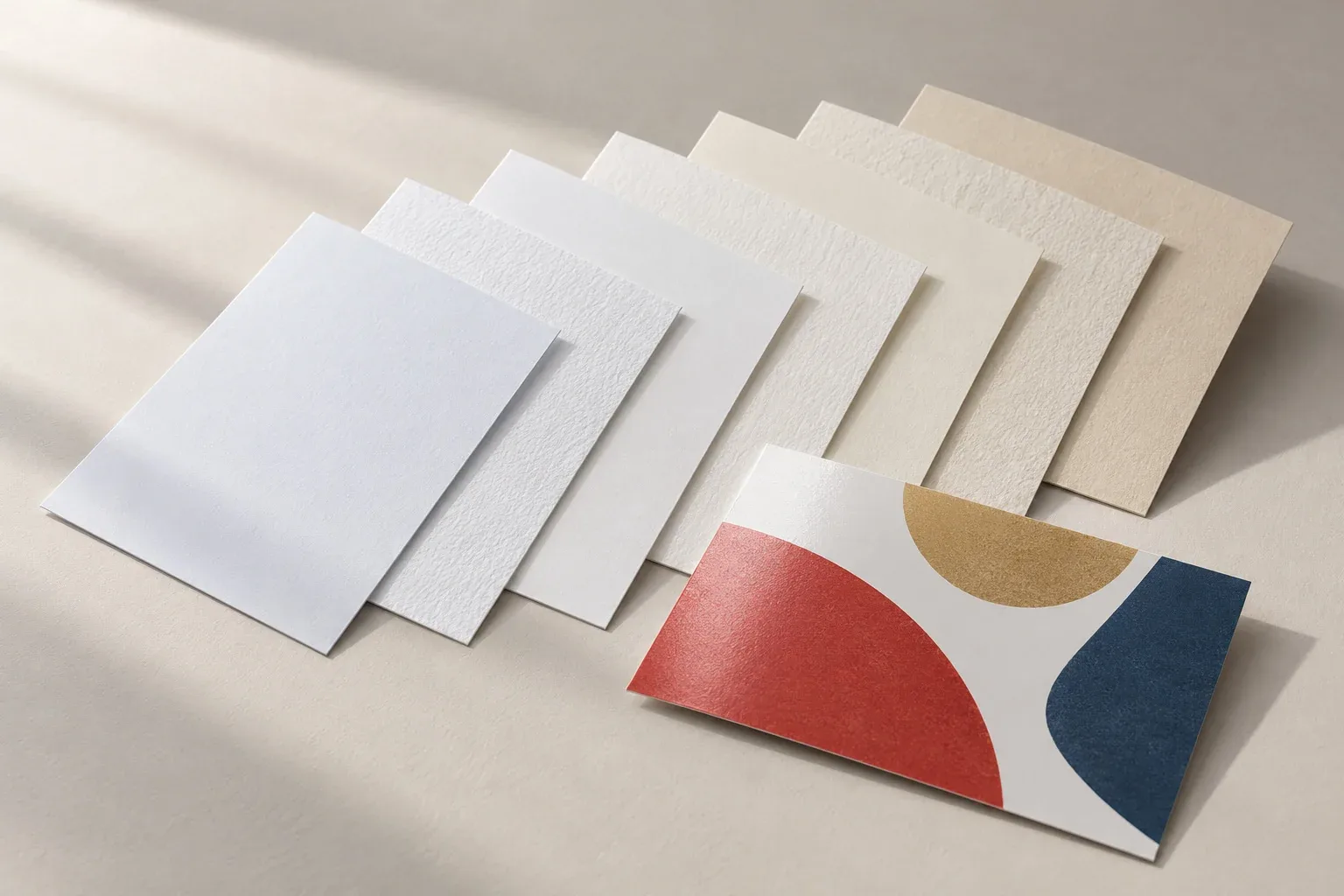
When a project moves between brand, designer, converter and printer, the same word often means different things. These are the 12 terms used most when specifying specialty paper, each explained briefly enough to paste into a material brief.
What is grammage (gsm)?
The weight of one square metre of paper, in g/m². Grammage is not thickness: two papers of the same grammage can differ noticeably in caliper.
What is caliper?
The physical thickness of a single sheet, usually given in microns (μm) or millimetres, or in points (thousandths of an inch) in imperial markets. Carton structures, die-cutting and press settings usually depend on caliper rather than grammage.
What is bulk?
The ratio of caliper to grammage. At the same grammage, a higher-bulk paper is thicker and feels more substantial, which makes bulk a better basis than grammage alone for comparing papers.
Why does grain direction matter?
During papermaking most fibres align with the direction the machine runs. Folding with the grain is smoother; folding across it is more likely to crack, and stiffness differs in each direction. Decide grain direction for cartons, books and cards before imposition.
What is the difference between coated and uncoated paper?
Coated paper carries a surface coating for sharper detail and stronger colour; uncoated paper keeps the feel of the fibre, absorbs more ink and gives softer colour. VANGLAM IMPRINT offers both: uncoated 素映 and coated 细映.
What is colour-through paper?
Paper coloured at the pulp stage, so face and core match and cut edges, scores and tears never show white. VANGLAM PALETTE is colour-through.
What is pearlescent paper?
Paper whose coating contains pearlescent pigment, so its sheen changes with the viewing angle. It is not the same as foil: the sheen belongs to the sheet, while foil is an applied finish.
How does soft-touch paper differ from soft-touch film?
Soft-touch paper gets its feel from a surface coating, with no lamination; soft-touch film is a plastic film applied after printing. Skipping the film removes a process step.
How is embossed paper made?
Texture can be pressed in while the web is still wet during papermaking, or afterwards with embossing rollers. VANGLAM GRAINFORM is a full wood-pulp base paper with wet embossing. Texture depth affects fine type, solid coverage and scoring, so confirm them together in the proof.
What is a Master Sample?
A physical sheet signed off by both parties that records colour, hand feel, grammage and surface; every production batch is checked against it.
What is D50 lighting?
The standard viewing light for the graphic arts, around 5000 K (see ISO 3664). The same sheet looks different under different light, so colour should always be compared under one standard source.
What is colour difference (ΔE)?
The numerical difference between two colours measured with a spectrophotometer. Acceptable tolerance depends on the surface and the project, and should be agreed in writing before production.