
How to proof embossed and textured specialty paper: test solids, register, varnish and lamination separately
Proof and approve image, register, surface treatment and carton construction separately on textured paper.
Texture adds value and variables
Texture creates the visual and tactile value of a specialty sheet, but it also makes the printed result more process-dependent. A blank dummy or a small colour patch cannot establish whether a solid reaches the low areas of a texture, whether fine detail remains legible, whether repeat passes hold register, or whether varnish and film produce the intended surface.
Use grade-specific guidance as a test method
Fedrigoni’s Mistral Tradition sheet calls for material-specific pressure settings, advance evaluation of multi-pass register, and assessment of varnishing and laminating. It is evidence about that named grade, not a claim about a QiLi product. The transferable method is to identify the texture and both sides, then test the actual printing and finishing sequence.
Separate the acceptance questions
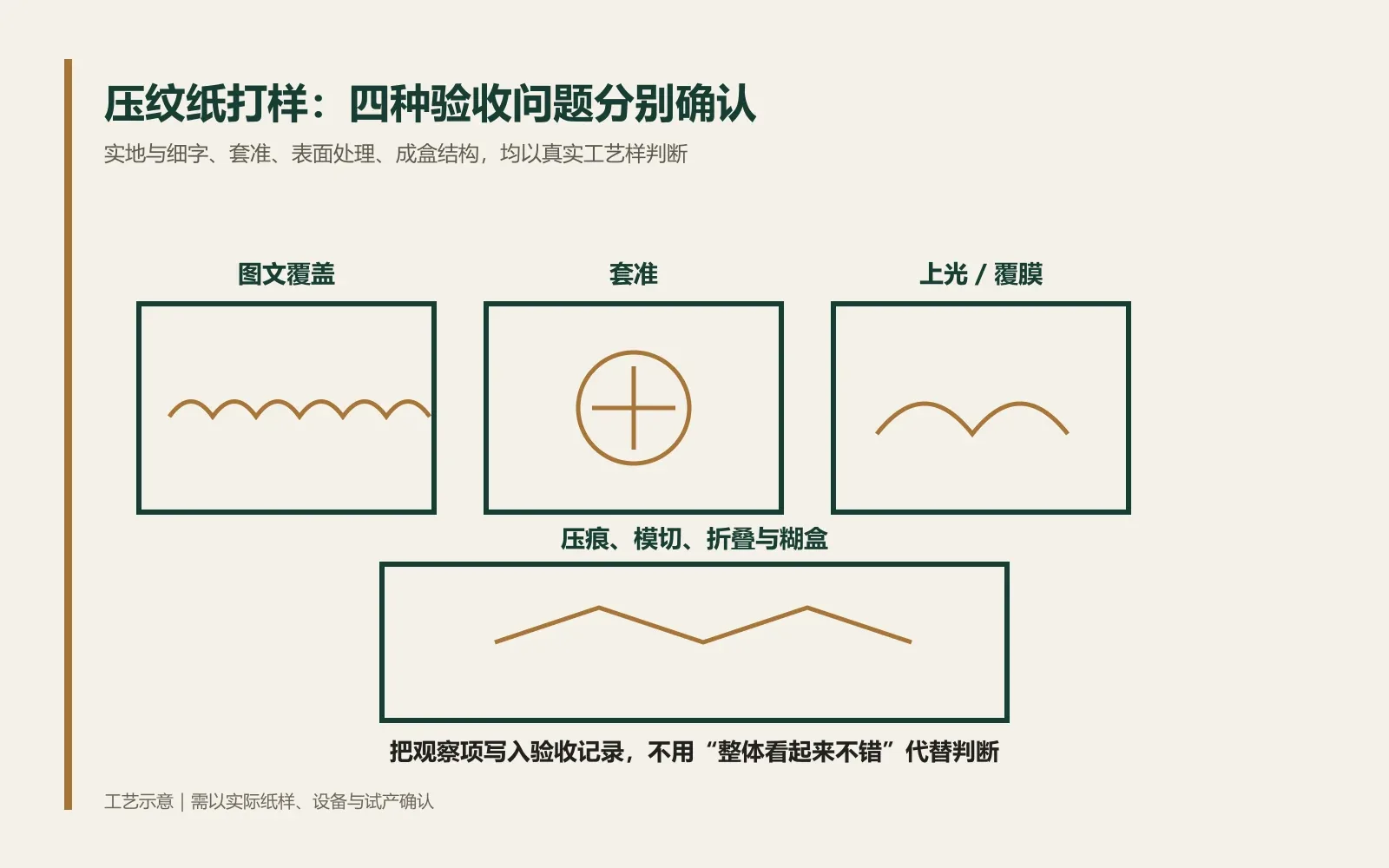
Use proof panels with separate acceptance questions. Test type, hairlines, tonal images and solids at the most pronounced texture; then test multi-colour or repeat-pass register; then test varnish, spot treatment, film or protective layer over both printed and unprinted areas; finally test creasing, die-cutting, folding, gluing and corners. One sheet can include several panels, but record each result independently.
Approve the finished object and the recorded version
Give the printer the side to print, texture pattern/direction, grammage and caliper information, artwork revision, print process, coverage, drying or curing route and finishing order. Record the actual press, consumables, relevant settings and waiting intervals on the proof rather than importing another manufacturer’s machine settings. Approve the sample under the finished viewing conditions and repeat the check whenever the paper, coverage, finishing sequence or construction changes.
Project checklist
Does the image panel place solids, hairlines, reverse type and gradients at the strongest texture?
Does the register panel include multi-colour, repeat-pass and aligned foil or embossing where relevant?
Does the surface panel inspect varnish or film over both printed and unprinted areas?
Does the structural sample record the findings for creasing, die-cutting, folding, gluing and corners?
Short guide: four checks before sampling
An original silent explainer with Chinese captions. The diagrams illustrate process checks, not photographs or performance results for a specific paper grade.
Sources and scope
Prepared using the references below, checked on 9 October 2026. Recommendations for different brands and grades are not interchangeable; confirm production conditions against the selected grade's documentation and physical press trials. Illustrations and animation are original explanatory graphics.
Fedrigoni, Mistral Tradition product data sheet (rev. 01/2024)
Antalis, Conqueror Connoisseur technical data sheet (August 2024)