
How to condition specialty paper before press: from delivery to unopened leftovers
Build a traceable pre-press conditioning record from delivery and wrapped acclimation to controlled opening and leftover protection.
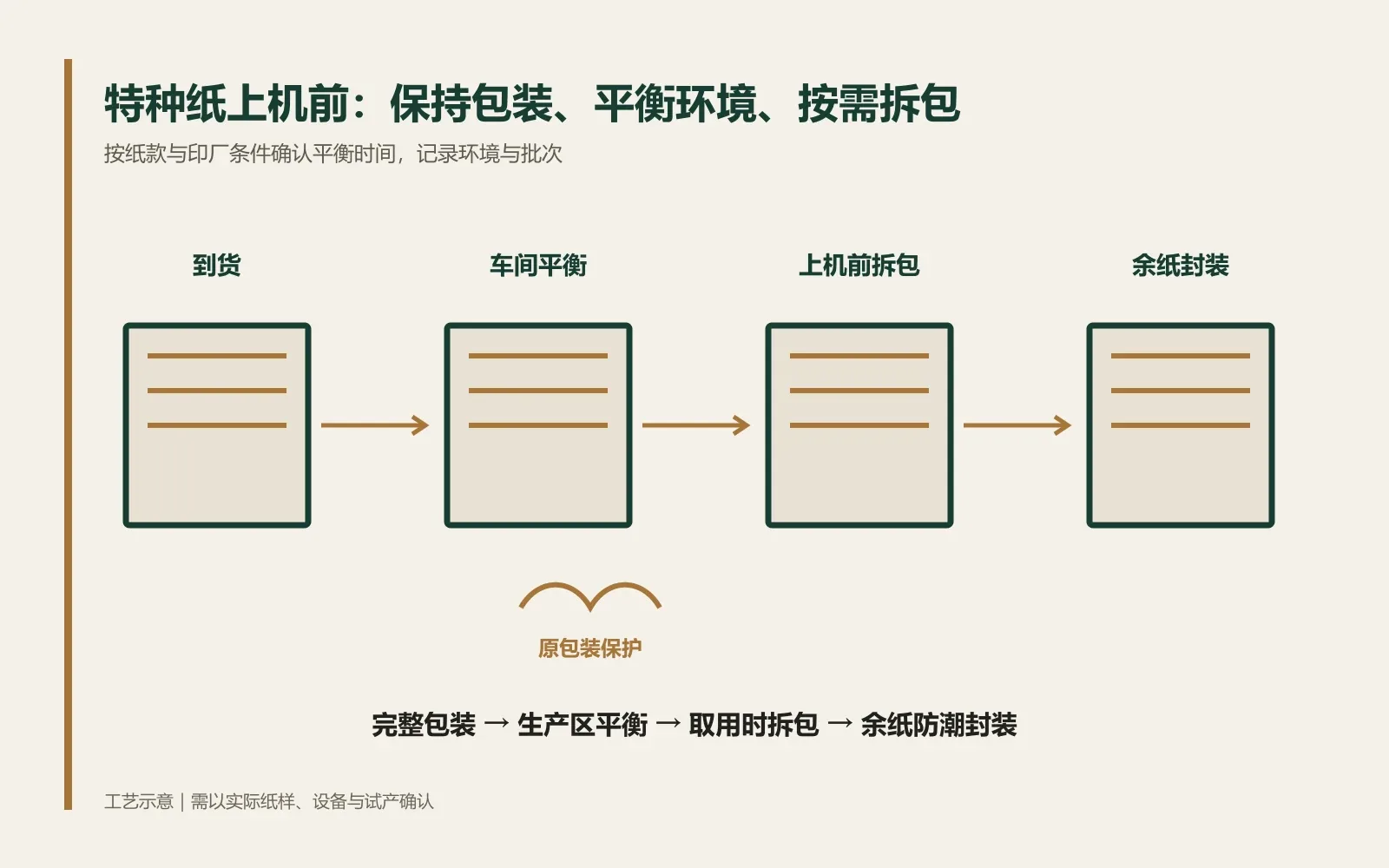
Identify the climate difference first
Paper arriving from a warehouse, vehicle or different climate should be allowed to equilibrate before it is exposed on press. Paper fibres exchange moisture with the surrounding air. If the edges gain or lose moisture before the centre does, sheets may develop wavy or tight edges. Sappi links these conditions to risks such as register variation, wrinkles, slur and fold cracking. This is a risk explanation, not a universal climate specification for every QiLi grade.
Keep receiving and pre-press records
Record the difference before acting on it. At receiving, note wrap integrity and any obvious difference between paper temperature and pressroom climate, as well as storage near cold walls, doors, heat sources or damp floors. Where tight register, multiple passes, heavy coverage or precise converting matter, the printer should compare conditions inside the load with the pressroom and retain the reading, time and batch reference.
Keep the wrap intact and confirm the interval locally
Keep mill moisture barriers intact while the stock acclimates, then open only what the press needs. Sappi and Antalis give acclimation guidance for their named products and conditions; it is not a specification for another stock. The required interval depends on temperature difference, load size, wrapping and the local pressroom; confirm it with the relevant supplier and printer.
Protect leftovers and investigate exceptions
After opening, protect unused stock and printed loads between passes with the original wrap or appropriate moisture protection. Keep sheets off concrete and away from vents, radiators and cold walls. If waviness, tight edges, static or poor feeding appears, retain the affected stock, log conditions and opening time, and obtain machine- and material-specific advice before an unapproved corrective action. Archive the environmental record with the approved sample and process sequence.
Project checklist
Was wrap integrity and any material-to-pressroom climate difference noted at receiving?
Did the stock remain wrapped in the intended production area until it was needed?
For tight register or repeat passes, were load and pressroom conditions recorded with time and batch?
Are leftovers, printed loads and affected sheets protected and traceable by stock/batch and handling record?
Short guide: four checks before sampling
An original silent explainer with Chinese captions. The diagrams illustrate process checks, not photographs or performance results for a specific paper grade.
Sources and scope
Prepared using the references below, checked on 9 October 2026. Recommendations for different brands and grades are not interchangeable; confirm production conditions against the selected grade's documentation and physical press trials. Illustrations and animation are original explanatory graphics.