
110 or 240 gsm colored paper? Choose for the finished piece
PALETTE 110 gsm offers a flexible, conformable feel. At 240 gsm, the paper has more substance and support. Compare them in the intended construction.
Choose for the job
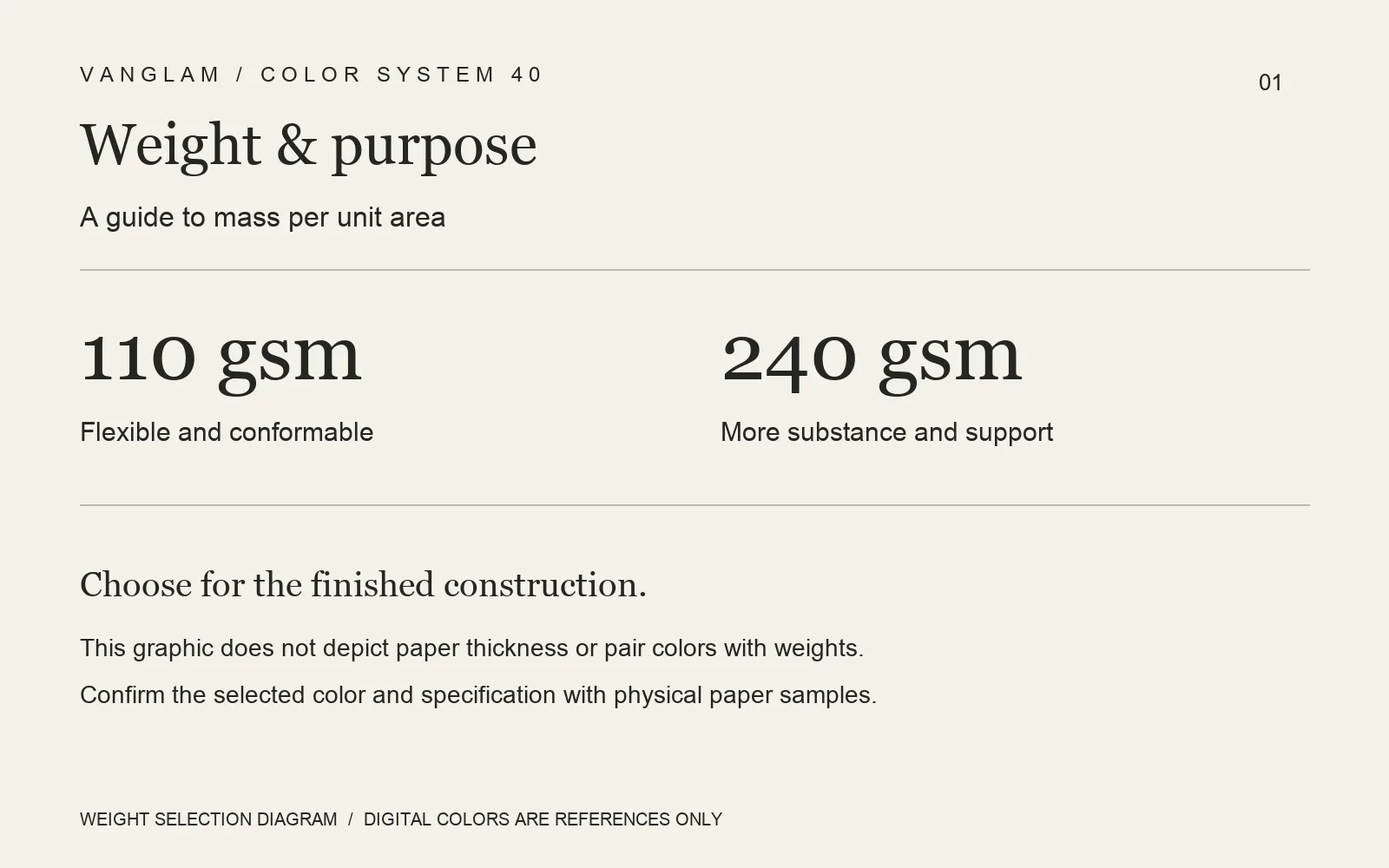
Within PALETTE 40, 110 gsm has a flexible, conformable character; 240 gsm offers a more substantial feel and a degree of support. Grammage describes mass per unit area. It does not settle how a finished piece will feel.
Fit or handling?
For wraps, liners or folded layers, use 110 gsm samples to explore corners, folds and bonded areas. For cards, tags or components needing some support, consider 240 gsm as a sampling direction. Compare both with the actual substrate, construction and converting process. Paper weight is one part of that decision.
FAQ: Is 240 gsm always better for packaging?
No. A wrap and a freestanding card have different jobs. Grammage cannot be translated directly into a load-bearing rating. Compare finished samples before selecting the specification.
When requesting samples, state the color, application and process. Confirm availability for the particular color and weight combination. Digital colors are references only; approve color on physical paper and performance through project proofs.
Cover: an original weight-selection diagram, not a depiction of paper thickness or fixed color-and-weight combinations. Confirm color and surface with physical samples.